課題Ⅱ 第4編② 技術的安全管理措置の実施項目
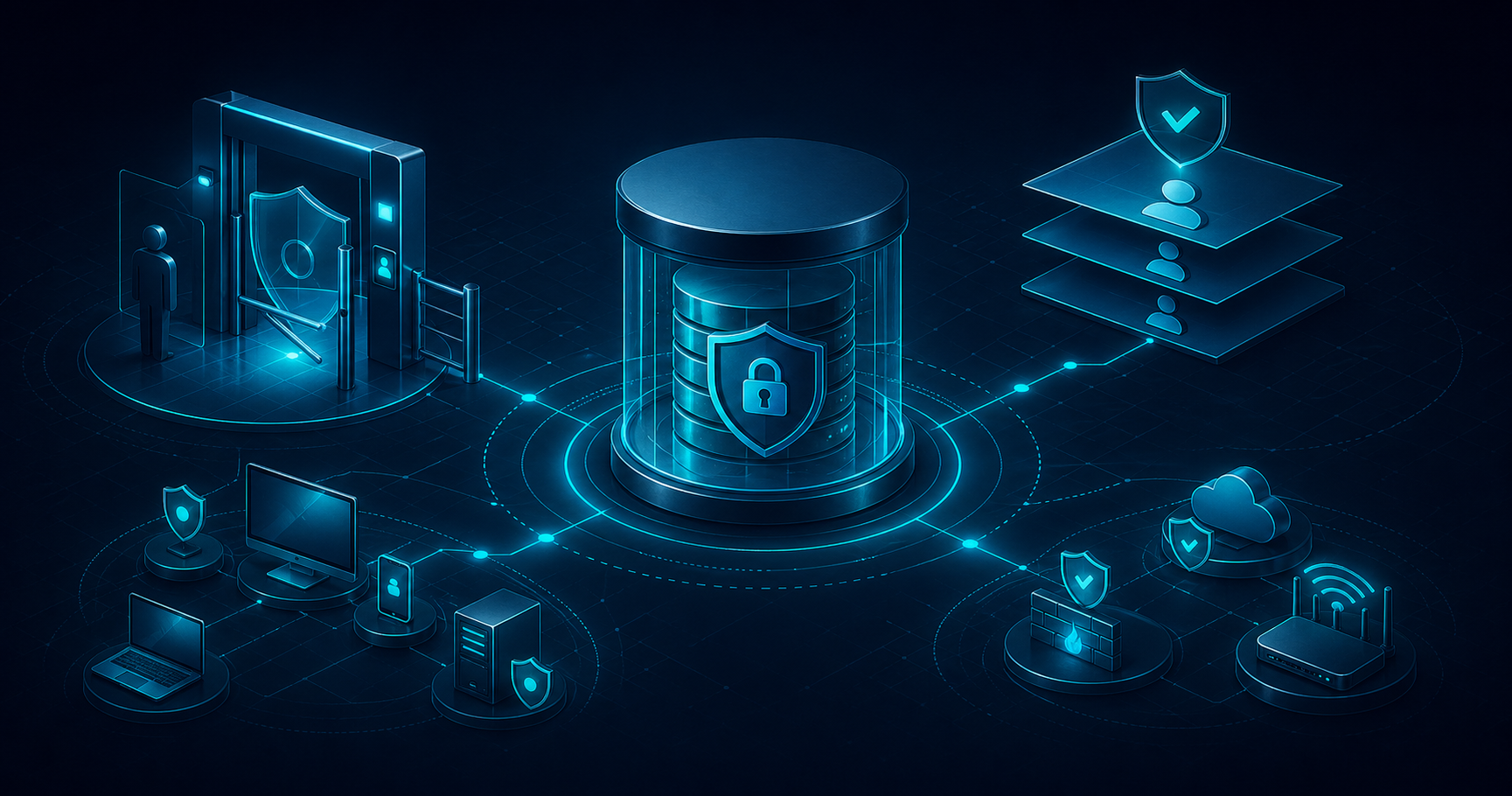
技術的安全管理措置の実施項目として、ガイドライン通則編10-6では大きく4つの柱を定めています。(a)アクセス制御、(b)アクセス者の識別と認証、(c)外部からの不正アクセス等の防止、(d)情報システムの使用に伴う漏えい等の防止です。本記事では、これらの具体的な実施内容に加え、ログ管理・マルウェア対策・テレワーク/クラウドセキュリティまで網羅します。
The guideline general rules edition 10-6 establishes four main pillars as implementation items for technical safety management measures: (a) access control, (b) identification and authentication of access persons, (c) prevention of unauthorized external access, and (d) prevention of leaks accompanying information system use. This article covers the specific implementation details of each, plus log management, malware countermeasures, and telework/cloud security.
(a) アクセス制御
まず(a)アクセス制御について。個人データを取り扱う端末と情報システムを限定することが出発点です。業務上必要のない従業員が個人データに触れられないよう、担当者ごとにアクセス権限を設定します。異動・退職などで不要になった権限は速やかに削除しなければなりません。さらに、権限の定期的な棚卸しを行い、過剰な権限が残っていないかを確認します。最小権限の原則(Principle of Least Privilege)に基づく運用が求められます。
First, regarding (a) access control. The starting point is limiting the terminals and information systems that handle personal data. Access privileges are set per person in charge so that employees without a business need cannot touch personal data. Privileges that become unnecessary due to transfer or resignation must be promptly deleted. Furthermore, regular inventory checks of privileges are conducted to confirm no excessive permissions remain. Operation based on the Principle of Least Privilege is required.
(b) アクセス者の識別と認証
(b)アクセス者の識別と認証では、まずID管理が基盤となります。共有IDの使用は禁止し、従業員一人ひとりに一意のIDを付与します。退職者・異動者のIDは速やかに無効化・削除し、不正利用を防ぎます。
In (b) identification and authentication of access persons, ID management forms the foundation. Shared IDs are prohibited, and a unique ID is assigned to each individual employee. IDs of former employees and transferred personnel are promptly deactivated or deleted to prevent unauthorized use.
パスワードポリシーについては、最新の動向を踏まえる必要があります。NIST SP 800-63Bの影響を受け、従来の「定期的なパスワード変更」よりも、十分な長さ(最低8文字以上、推奨12文字以上)と複雑性を重視する方向にシフトしています。一定回数の認証失敗でアカウントをロックする仕組み(アカウントロック)も必須です。さらに、多要素認証(MFA)の導入が強く推奨されており、知識要素(パスワード)・所持要素(トークン、スマートフォン)・生体要素(指紋、顔認証)のうち2つ以上を組み合わせます。
Regarding password policy, it is necessary to take into account the latest trends. Under the influence of NIST SP 800-63B, the emphasis has shifted from conventional "regular password changes" toward sufficient length (minimum 8 characters, recommended 12 or more) and complexity. A mechanism that locks accounts after a fixed number of authentication failures (account lock) is also mandatory. Furthermore, introduction of multi-factor authentication (MFA) is strongly recommended, combining two or more of: knowledge factors (password), possession factors (token, smartphone), and biometric factors (fingerprint, facial recognition).
認証要素は3種類に分類されます。知識要素(something you know)はパスワード・PIN・秘密の質問など「本人しか知らない情報」です。所持要素(something you have)はICカード・物理トークン・登録済みスマートフォンへのプッシュ通知など「本人が物理的に持つもの」です。生体要素(something you are)は指紋・顔・虹彩・静脈など「本人そのものの身体特徴」です。MFA(多要素認証)と呼ぶには、異なる種類の要素を組み合わせる必要があり、「パスワード+秘密の質問」のように同一要素(共に知識)の組み合わせは多要素とは呼びません(多段階認証)。
Authentication factors are classified into three types. Knowledge factor (something you know): passwords, PINs, secret questions — "information only the person knows." Possession factor (something you have): IC cards, physical tokens, push notifications to a registered smartphone — "things the person physically possesses." Biometric factor (something you are): fingerprint, face, iris, vein — "physical characteristics of the person themselves." To be called MFA (multi-factor authentication), different categories of factors must be combined; combinations of the same factor type (both knowledge), like "password + secret question," are not multi-factor (this is multi-step authentication).
(c) 外部からの不正アクセス等の防止
(c)外部からの不正アクセス等の防止では、ファイアウォールが基本中の基本です。外部ネットワークとの境界に設置し、許可された通信だけを通過させるルールを設定・管理します。不要なポートは閉鎖し、ルールは定期的に見直します。ウイルス対策ソフトを導入し、パターンファイルの自動更新とリアルタイムスキャンを有効にしておくことが前提です。
For (c) prevention of unauthorized external access, the firewall is the most fundamental measure. It is installed at the boundary with external networks, with rules configured and managed to allow only permitted communication through. Unnecessary ports are closed, and rules are reviewed regularly. Introducing antivirus software with automatic pattern file updates and real-time scanning enabled is a prerequisite.
脆弱性管理も重要な柱です。OS・ミドルウェア・アプリケーションのセキュリティパッチを適時適用し、既知の脆弱性を放置しないことが鉄則です。脆弱性情報はJVN(Japan Vulnerability Notes)やCVE(Common Vulnerabilities and Exposures)から収集します。Webサービスを提供する場合はWAF(Web Application Firewall)を導入してSQLインジェクションやクロスサイトスクリプティングなどの攻撃を防御します。IDS(侵入検知システム)やIPS(侵入防止システム)を併用することで、ネットワーク上の不審な通信を検知・遮断できます。
Vulnerability management is also a key pillar. Timely application of security patches for OS, middleware, and applications — never leaving known vulnerabilities unaddressed — is an iron rule. Vulnerability information is collected from JVN (Japan Vulnerability Notes) and CVE (Common Vulnerabilities and Exposures). When providing web services, WAF (Web Application Firewall) is introduced to defend against attacks such as SQL injection and cross-site scripting. By also deploying IDS (Intrusion Detection System) and IPS (Intrusion Prevention System), suspicious communication on the network can be detected and blocked.
標的型攻撃(APT:Advanced Persistent Threat)は、特定の組織を狙って長期間にわたり潜伏・情報窃取を行う攻撃です。典型的な入口は標的型メール(spear phishing)で、業務関連を装った添付ファイルやリンクから感染します。対策は単一の技術では不十分で、入口対策(メールフィルタ・サンドボックス)、内部対策(権限分離・特権ID管理・EDR)、出口対策(外部通信監視・DLP)の多層防御が必須です。従業員教育(疑わしいメールを開かない・報告する)も決定的に重要です。
Targeted attacks (APT: Advanced Persistent Threat) target a specific organization and lurk over long periods to steal information. The typical entry point is targeted email (spear phishing), with infection occurring via attachments or links disguised as business-related. Countermeasures cannot rely on a single technology — multi-layered defense is mandatory: entry-point measures (mail filters, sandboxes), internal measures (privilege separation, privileged ID management, EDR), and exit measures (external communication monitoring, DLP). Employee training (don't open suspicious mail, report it) is also critically important.
ゼロトラスト(Zero Trust)は、社内ネットワークも信頼しないという考え方に基づくセキュリティモデルです。従来の境界防御(ファイアウォールで内と外を分け、内側は信頼)が、テレワーク・クラウド普及・内部不正増加により機能しなくなったことが背景にあります。「Never Trust, Always Verify(決して信頼せず、常に検証せよ)」を原則とし、全てのアクセス要求を毎回認証・認可します。実装には、継続的な認証(機器状態・場所・時刻の動的評価)、最小権限、マイクロセグメンテーション(ネットワーク細分化)が用いられます。
Zero Trust is a security model based on the philosophy of not trusting even the internal network. The background is that traditional perimeter defense (firewalls separating inside from outside, with inside trusted) has stopped functioning due to telework, cloud adoption, and increasing internal fraud. Its principle is "Never Trust, Always Verify" — every access request is authenticated and authorized every time. Implementation uses continuous authentication (dynamic evaluation of device state, location, time), least privilege, and micro-segmentation (fine-grained network segmentation).
(d) 情報システムの使用に伴う漏えい等の防止
(d)情報システムの使用に伴う漏えい等の防止では、まず通信の暗号化が基本です。個人データを送受信する際はTLS 1.2以上を使用し、社外からの接続にはVPN(仮想プライベートネットワーク)を利用して通信経路を保護します。TLS 1.0/1.1は既に非推奨であり、使用を停止すべきです。
In (d) prevention of leaks accompanying information system use, communication encryption is fundamental. TLS 1.2 or higher is used when transmitting and receiving personal data, and VPN (Virtual Private Network) is used to protect the communication route for connections from outside the company. TLS 1.0/1.1 are already deprecated and their use should be ceased.
メールセキュリティも重要な対策領域です。個人データを含む添付ファイルはS/MIMEやPGPで暗号化し、誤送信防止策として送信先確認ダイアログや上長承認フローを導入します。外部記録媒体(USBメモリ等)の利用も制限すべきであり、USB制御ソフトやデバイス制御ポリシーで許可されていない媒体の接続を禁止します。
Email security is also an important countermeasure area. Attachments containing personal data are encrypted with S/MIME or PGP, and as erroneous transmission prevention measures, destination confirmation dialogs and superior approval flows are introduced. Use of external recording media (USB drives, etc.) should also be restricted, using USB control software and device control policies to prohibit connection of unauthorized media.
DLP(Data Loss Prevention)は、個人データの不正な持ち出しを防ぐ仕組みです。コンテンツインスペクション機能により、メール本文・添付ファイル・クラウドストレージへのアップロードなどを監視し、個人データに該当する情報が含まれていれば送信をブロックまたは警告します。意図的な内部不正と過失による漏えいの両方に対応できる点が強みです。
DLP (Data Loss Prevention) is a mechanism for preventing unauthorized removal of personal data. Through content inspection functionality, it monitors email body text, attachments, uploads to cloud storage, etc., and blocks or warns transmission when information applicable to personal data is detected. Its strength is that it can address both intentional internal fraud and leaks caused by negligence.
暗号化アルゴリズムは共通鍵暗号と公開鍵暗号に大別されます。共通鍵暗号(AES、3DES等)は暗号と復号に同一の鍵を使用し、処理が高速ですが、鍵配送問題があります。現行推奨はAES-256で、3DESやDESは既に非推奨です。公開鍵暗号(RSA、楕円曲線暗号=ECC等)は公開鍵と秘密鍵の対を用い、処理は遅いが鍵配送問題を解決します。実務では両者を組み合わせるハイブリッド方式(TLSなど)が一般的で、共通鍵を公開鍵で安全に交換します。鍵管理は暗号化以上に重要で、HSM(Hardware Security Module)や鍵管理サービス(KMS)で集中管理し、定期的に更新します。
Encryption algorithms are broadly classified into symmetric-key and public-key encryption. Symmetric-key encryption (AES, 3DES, etc.) uses the same key for encryption and decryption — fast processing but with key distribution problems. Currently AES-256 is recommended; 3DES and DES are already deprecated. Public-key encryption (RSA, Elliptic Curve Cryptography = ECC, etc.) uses a public/private key pair — slow processing but solves the key distribution problem. In practice, hybrid methods combining both (such as TLS) are common, securely exchanging the symmetric key via the public key. Key management is even more important than encryption itself: centrally managed via HSM (Hardware Security Module) or KMS (Key Management Service), with regular rotation.
ログ管理
技術的安全管理措置を実効的にするためには、ログ管理が不可欠です。取得すべきログは多岐にわたります。アクセスログ(誰がいつどのデータに触れたか)、操作ログ(ファイル操作・印刷・コピー)、認証ログ(ログイン成功/失敗)、通信ログ(送受信記録)の4種類が代表的です。
Log management is indispensable for making technical safety management measures effective. The logs that should be collected are wide-ranging: access logs (who touched which data and when), operation logs (file operations, printing, copying), authentication logs (login successes/failures), and communication logs (transmission and reception records) are the four representative types.
ログの保管にも注意が必要です。改ざん防止のため、WORM(Write Once Read Many)媒体への書き込みや、運用サーバとは別のログ専用サーバへの転送が推奨されます。保管期間は法令や社内規程に従い設定しますが、最低でも1年以上の保存が望ましいとされています。ログ管理規程を整備し、取得・保管・廃棄のルールを明文化しておくことが大切です。
Caution is also needed for log storage. To prevent falsification, writing to WORM (Write Once Read Many) media or transferring to a dedicated log server separate from the operation server is recommended. The retention period is set according to laws, regulations, and internal rules, but a minimum of one year or more is considered desirable. It is important to prepare log management regulations and codify rules for acquisition, storage, and disposal.
ログの定期的なレビューにより、不審なパターンを早期に発見できます。大量のログを効率的に分析するには、SIEM(Security Information and Event Management)の導入が有効です。SIEMは複数のログを統合・相関分析し、単体のログでは見えない攻撃パターンを検出してアラートを発報します。例えば、深夜の大量ダウンロードと直後のUSB接続という組み合わせは、内部不正の兆候として検知できます。
Regular log reviews enable early discovery of suspicious patterns. SIEM (Security Information and Event Management) is effective for efficiently analyzing large volumes of logs. SIEM integrates and performs correlation analysis on multiple logs, detecting attack patterns invisible in standalone logs and issuing alerts. For example, a combination of mass downloads late at night followed immediately by a USB connection can be detected as a sign of internal fraud.
マルウェア対策
マルウェア対策の第一歩はウイルス対策ソフトです。検知方式は大きく3つあります。パターンマッチング(既知のマルウェアの特徴を定義ファイルと照合)、ヒューリスティック検知(未知のマルウェアを構造的特徴から推定)、ビヘイビア分析=振る舞い検知(実行時の動作を監視し不審な挙動を検知)です。これら3つの方式を組み合わせることで検知率を高めます。
The first step in malware countermeasures is antivirus software. There are three main detection methods: pattern matching (comparing against definition files of known malware characteristics), heuristic detection (estimating unknown malware from structural characteristics), and behavior analysis (monitoring operations during execution to detect suspicious behavior). Combining these three methods enhances the detection rate.
EDR(Endpoint Detection and Response)は、従来のウイルス対策ソフトを補完する仕組みです。端末の挙動を常時監視し、不審な挙動を検知した場合に自動で隔離・対応します。未知のマルウェアや標的型攻撃にも対応できる点が強みです。サンドボックスは、未知の疑わしいファイルを仮想環境で実行し、安全に挙動を確認する技術です。本番環境に影響を与えずにマルウェアかどうかを判定できます。
EDR (Endpoint Detection and Response) is a mechanism that supplements conventional antivirus software. It constantly monitors terminal behavior and automatically isolates and responds when suspicious behavior is detected. Its strength is the ability to handle unknown malware and targeted attacks. A sandbox is a technology that executes unknown suspicious files in a virtual environment to safely confirm their behavior, enabling malware determination without affecting the production environment.
マルウェアに感染した場合の対応手順も事前に定めておきます。第一に、感染した端末をネットワークから隔離します。次に責任者に報告し、感染範囲と原因を調査します。その後、マルウェアの駆除とシステムの復旧を行い、最後に再発防止策を講じます。つまり「隔離→報告→調査→駆除→復旧→再発防止」の流れです。
Response procedures in case of malware infection must also be established in advance. First, the infected terminal is isolated from the network. Next, the responsible person is notified and the scope of infection and cause are investigated. After that, malware removal and system recovery are performed, and finally recurrence prevention measures are taken. In other words, the flow is: isolation → report → investigation → removal → recovery → recurrence prevention.
テレワーク・クラウドセキュリティ
テレワーク環境では、社外から社内システムへ安全に接続する手段が必要です。VPN、リモートデスクトップ、VDI(仮想デスクトップ基盤)が主な選択肢です。VDIでは端末にデータが残らないため、紛失・盗難時の漏えいリスクを低減できます。BYOD(Bring Your Own Device)に対しては、MDM(Mobile Device Management)で端末を一元管理し、MAM(Mobile Application Management)で業務アプリを個人領域と分離するコンテナ化が有効です。
In telework environments, means for safely connecting to internal systems from outside are necessary. VPN, remote desktop, and VDI (Virtual Desktop Infrastructure) are the main options. With VDI, no data remains on the terminal, so leakage risk in case of loss or theft can be reduced. For BYOD (Bring Your Own Device), MDM (Mobile Device Management) for centralized terminal management and MAM (Mobile Application Management) with containerization to separate business apps from the personal area are effective.
クラウドサービス利用時は、責任共有モデルの理解が不可欠です。IaaSでは、事業者は物理基盤の管理責任を負い、OS・ミドルウェア・アプリケーション・データの管理は利用者の責任です。PaaSではOS・ミドルウェアまで事業者が管理し、SaaSではアプリケーションまで事業者側の責任となります。ただし、SaaSでもデータの入力内容やアクセス権限の設定は利用者の責任です。データの所在地が外国サーバの場合は、個人情報保護法第28条(外国にある第三者への提供の制限)の適用を検討しなければなりません。
When using cloud services, understanding the shared responsibility model is indispensable. In IaaS, the provider bears responsibility for managing the physical infrastructure, while management of OS, middleware, applications, and data is the user's responsibility. In PaaS, the provider manages up to the OS and middleware; in SaaS, the provider is responsible up to the application. However, even in SaaS, data input content and access privilege settings remain the user's responsibility. When data is located on foreign servers, application of Article 28 of the Personal Information Protection Act (restrictions on provision to third parties in foreign countries) must be considered.
クラウドセキュリティの国際規格として、ISO 27017(クラウドセキュリティ管理策)とISO 27018(クラウド上の個人識別可能情報の保護)があります。委託先のクラウド事業者がこれらの認証を取得しているかどうかは、選定時の重要な判断基準となります。これらの技術的措置を組織的・人的・物理的な安全管理措置と併せて実施することが、個人情報保護法の求める安全管理措置の実現につながります。
As international standards for cloud security, there are ISO 27017 (cloud security controls) and ISO 27018 (protection of personally identifiable information in the cloud). Whether the outsourcing cloud provider has obtained these certifications is an important selection criterion. Implementing these technical measures together with organizational, human, and physical safety management measures leads to realizing the safety management measures required by the Personal Information Protection Act.