課題Ⅱ 第3編 オフィスセキュリティ
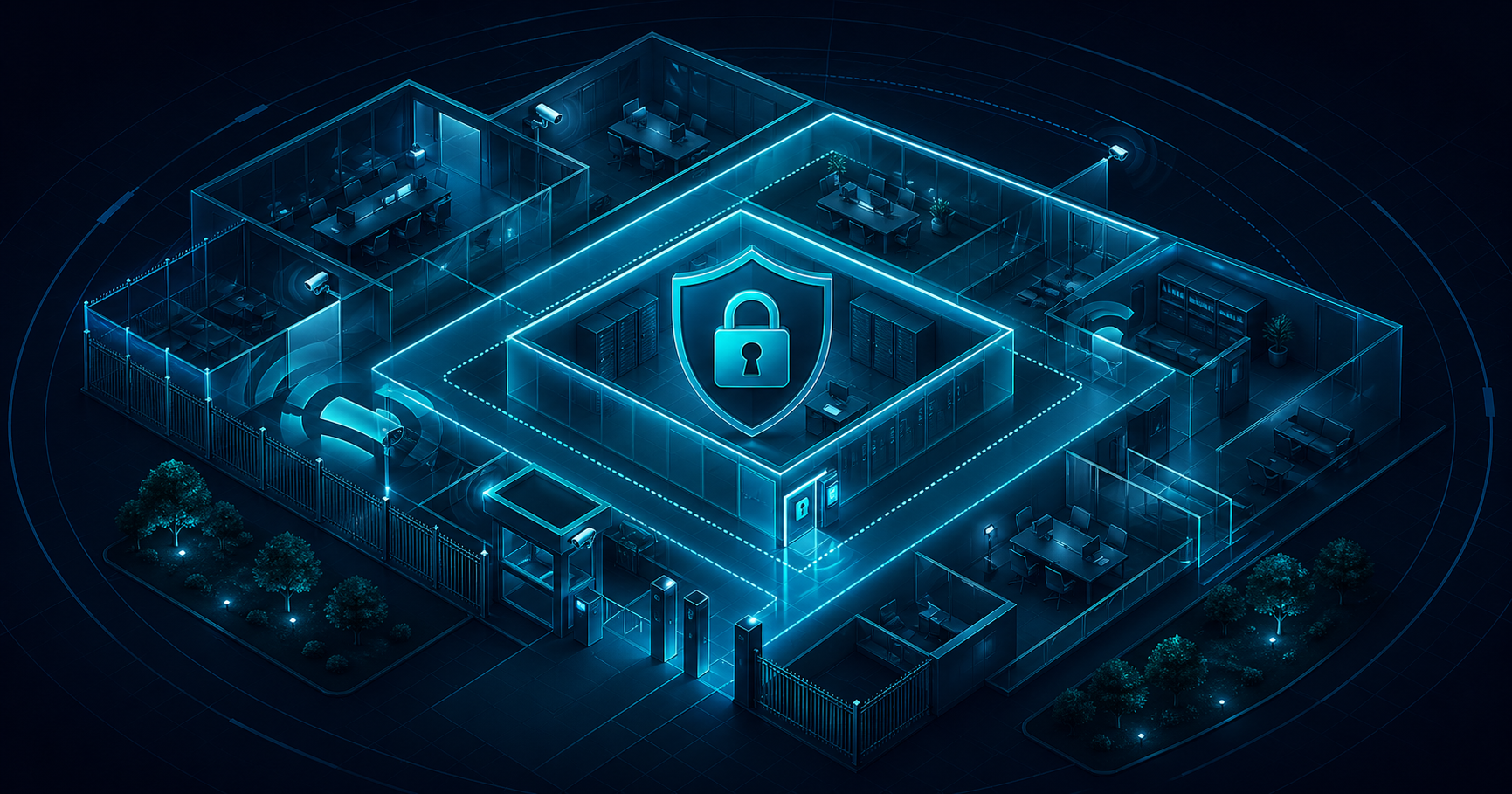
個人情報を保護するためには、技術的な対策だけでなく、物理的なセキュリティ対策も不可欠です。オフィスセキュリティとは、建物や施設への不正な侵入を防ぎ、情報資産を物理的に守るための取組みを指します。基本原則は多層防御(defense in depth)であり、建物の外周からフロア、部屋、キャビネット、端末機器へと段階的に防御層を設け、一つの層が突破されても次の層で食い止める考え方です。
To protect personal information, not only technical countermeasures but also physical security measures are indispensable. Office security refers to initiatives to physically protect information assets by preventing unauthorized intrusion into buildings and facilities. The basic principle is defense in depth: establishing layers of defense progressively from the building perimeter to the floor, room, cabinet, and terminal device, so that even if one layer is breached, the next layer can stop the threat.
セキュリティゾーニング
セキュリティゾーニングとは、オフィス内を重要度に応じて区域に分け、各区域に異なる入室制限と監視水準を設定する手法です。一般区域(パブリックエリア)は受付やロビーなど、来訪者が立ち入れる範囲です。業務区域は社員のみが利用する一般執務エリアです。セキュリティ区域はサーバールームや書類保管庫など、限られた担当者のみが入室できる区域です。高セキュリティ区域はデータセンターや金庫室など、最も厳格な管理が求められる区域です。外周から内側に進むほど制限が厳しくなる設計が基本です。
Security zoning is a method of dividing the office into zones according to their level of importance and setting different entry restrictions and surveillance levels for each zone. The general area (public area) is the scope visitors can enter, such as the reception and lobby. The work area is the general office area used only by employees. The secure area is a zone only designated personnel can enter, such as server rooms and document storage rooms. The high-security area is a zone requiring the strictest management, such as data centers and vaults. The basic design is that restrictions become stricter the further inside from the perimeter you go.
入退室管理
入退室管理では、許可された人物のみが該当する区域に立ち入れるようにします。主な認証方法として、ICカード、生体認証(指紋、虹彩、静脈)、暗証番号、物理鍵があります。セキュリティ区域以上では、二要素認証(例:ICカード+暗証番号)を組み合わせることが望ましいとされています。
In entry and exit management, only authorized persons are allowed to enter the applicable zone. Main authentication methods include IC cards, biometric authentication (fingerprint, iris, vein), PIN codes, and physical keys. For secure areas and above, combining two-factor authentication (e.g., IC card + PIN code) is considered desirable.
共連れ(テールゲーティング)とは、認証を受けた人に続いて未認証の人が入室することです。防止策として、アンチパスバック(入室記録がないと退室できない仕組み)、マントラップ(二重扉の小部屋で一人ずつ認証)、回転ドア、セキュリティゲートなどがあります。高セキュリティ区域ではマントラップが特に有効です。
Tailgating means an unauthenticated person enters a room by following someone who has been authenticated. Prevention measures include anti-passback (a mechanism where you cannot exit without an entry record), mantraps (authenticating one person at a time in a small room with double doors), revolving doors, and security gates. For high-security areas, mantraps are particularly effective.
来訪者管理も入退室管理の重要な要素です。来訪者は受付で記帳し、入館証を発行受けます。社内では必ず社員がエスコートし、単独での移動は認めません。退館時には入館証を返却させ、退館を確認します。入退室記録は一定期間保管し、定期的に確認・監査します。
Visitor management is also an important element of entry and exit management. Visitors register at reception and receive a visitor badge. Inside the company, an employee must always escort them; unaccompanied movement is not allowed. When leaving, visitors return their badge and their departure is confirmed. Entry and exit records are stored for a fixed period and periodically reviewed and audited.
物理的安全管理措置の実施項目(ガイドライン通則編10-5)
個人情報保護法のガイドライン通則編10-5では、物理的安全管理措置として四つの実施項目を規定しています。(a) 個人データを取り扱う区域の管理:管理区域(サーバールーム等)では入退室管理、施錠、持込み制限を実施します。取扱区域(一般オフィス)ではのぞき見防止のための座席配置、パーティションの設置などを行います。
The guidelines under the Act on Protection of Personal Information (General Rules Part 10-5) stipulate four implementation items as physical safety management measures. (a) Management of zones handling personal data: In management zones (server rooms, etc.), entry/exit management, locking, and restrictions on items brought in are implemented. In handling zones (general offices), measures such as seat arrangement to prevent shoulder surfing and installation of partitions are carried out.
(b) 機器及び電子媒体等の盗難等の防止:ワイヤーロック(ケンジントンロック)でノートPCを固定し、施錠できるキャビネットに電子媒体を保管します。サーバーラックは施錠し、携帯機器は管理台帳で貸出・返却を記録します。
(b) Prevention of theft of equipment and electronic media: Notebook PCs are secured with wire locks (Kensington locks) and electronic media are stored in lockable cabinets. Server racks are locked, and portable devices are tracked with a management ledger recording lending and return.
(c) 電子媒体等を持ち運ぶ場合の漏えい等の防止:USBメモリやノートPCは暗号化し、パスワード保護を施します。持出しには事前の申請・承認手続きが必要であり、誰が何を持ち出したかの追跡可能性を確保します。
(c) Prevention of leakage when carrying electronic media: USB drives and notebook PCs are encrypted and password-protected. Taking items out requires a prior application and approval procedure, and traceability of who took what is ensured.
(d) 個人データの削除及び機器、電子媒体等の廃棄:データ消去には専用ソフトによる上書き消去、磁気消去(デガウス)、物理破壊があります。廃棄後は廃棄証明書を取得し、記録を残します。紙文書はクロスカット以上のシュレッダーか、溶解処理で確実に廃棄します。
(d) Deletion of personal data and disposal of equipment/electronic media: Data erasure methods include overwriting with dedicated software, magnetic erasure (degaussing), and physical destruction. After disposal, a disposal certificate is obtained and records are kept. Paper documents are reliably disposed of using cross-cut shredders or higher, or dissolution processing.
監視
監視カメラ(CCTV)は出入口、廊下、重要区域に設置し、映像は一定期間(通常1〜3か月)保存します。ただし、従業員のプライバシーとの両立が必要であり、設置目的や撮影範囲を明示することが望まれます。入退室ログの監視では、深夜・休日の不審な入室パターンや頻繁な認証失敗を検知し、アラートを発する仕組みを整備します。
Surveillance cameras (CCTV) are installed at entrances/exits, corridors, and important areas, and footage is stored for a fixed period (typically 1-3 months). However, compatibility with employee privacy is necessary, and it is desirable to clearly state the installation purpose and recording scope. For monitoring entry/exit logs, a mechanism is established to detect suspicious entry patterns during late night/holidays and frequent authentication failures, and issue alerts.
災害対策
地震対策として、サーバーラックには耐震ラックや免震装置を導入し、転倒防止措置を講じます。重要なシステムは二重化(冗長構成)し、一方が損壊しても他方で継続できるようにします。
For earthquake countermeasures, earthquake-resistant racks and seismic isolation devices are introduced for server racks, and anti-toppling measures are taken. Critical systems are made redundant so that if one is damaged, operations can continue with the other.
火災対策として、サーバールームには不活性ガス消火設備(水を使わない消火方式)を設置します。一般区域にはスプリンクラー、防火区画、火災報知器を設置します。水害対策としては、サーバー機器を上階に設置し、防水対策を施します。停電対策として、UPS(無停電電源装置)で瞬断を防ぎ、自家発電設備で長時間の停電に備えます。
For fire countermeasures, inert gas fire suppression systems (which do not use water) are installed in server rooms. In general areas, sprinklers, fire compartments, and fire alarms are installed. For flood countermeasures, server equipment is placed on upper floors with waterproofing measures applied. For power outage countermeasures, UPS (uninterruptible power supply) devices prevent momentary interruptions, and private power generation equipment prepares for prolonged outages.
BCP(事業継続計画)
BCP(事業継続計画)は、大規模な災害や障害が発生した場合でも事業を中断させず、あるいは速やかに復旧するための計画です。重要な指標として、RPO(Recovery Point Objective:目標復旧時点)は「どの時点のデータまで戻すか」を定め、RTO(Recovery Time Objective:目標復旧時間)は「どれくらいの時間で復旧するか」を定めます。
BCP (Business Continuity Plan) is a plan to avoid interrupting business or to recover promptly even when large-scale disasters or failures occur. As important indicators, RPO (Recovery Point Objective) determines "to what point in time data should be restored," and RTO (Recovery Time Objective) determines "how long recovery should take."
バックアップでは3-2-1ルールが推奨されます:三つのコピーを保持し、二つの異なる媒体に保存し、一つは遠隔地に保管します。DR(ディザスタリカバリ)サイトには三種類あります。ホットサイトは常時稼働し、即座に切り替え可能です。ウォームサイトは機器は設置済みで、データの復元後に利用可能です。コールドサイトは場所と電源のみで、機器の搬入・設定が必要です。
For backup, the 3-2-1 rule is recommended: maintain three copies, save on two different media, and store one in a remote location. There are three types of DR (Disaster Recovery) sites. A hot site is always operational and can be switched to immediately. A warm site has equipment installed, and can be used after data restoration. A cold site has only the location and power supply; equipment must be brought in and configured.
バックアップには三つの方式があり、運用要件に応じて使い分けます。フルバックアップは全データを毎回丸ごと複製する方式で、復元が最も単純(最新のフルだけ戻せばよい)ですが、取得時間と保存容量が最大になります。増分バックアップは前回のバックアップ(フル又は増分)以降に変更された差分のみを保存するため、取得が最も高速で容量も最小ですが、復元には最新フル+以降の全増分を順番に適用する必要があり、復元時間は長くなります。差分バックアップは前回のフルバックアップ以降に変更されたデータを毎回保存するため、容量は増分より大きいものの、復元は最新フル+最新差分の二つだけで済み、増分より復元が単純です。
There are three backup methods, used differently according to operational requirements. Full backup copies all data in its entirety each time; restoration is simplest (just restore the latest full), but acquisition time and storage capacity are the largest. Incremental backup saves only the differences changed since the previous backup (full or incremental), so acquisition is fastest and capacity is smallest, but restoration requires applying the latest full plus all subsequent incrementals in order, making restoration time long. Differential backup saves data changed since the previous full backup each time; capacity is larger than incremental, but restoration only needs the latest full plus the latest differential, making restoration simpler than incremental.
RPOを限りなく零に近づけるためには、リアルタイムレプリケーション(同期複製)が用いられます。本番サイトの書き込みを遠隔地サイトに同時に反映することで、障害発生時にもデータの損失が発生しない(RPO=0)構成が実現できます。これを支えるDR(ディザスタリカバリ)サイトは稼働状態と切り替え時間(RTO)に応じて三類型に分類されます。ホットサイトは本番と同等の機器・データを常時同期し、数分以内に切り替え可能(RTO短・コスト最高)です。ウォームサイトは機器は設置済みで、データは定期バックアップから復元するため、数時間〜数日で復旧(RTO中・コスト中)。コールドサイトは場所・電源・回線のみが用意されており、機器搬入と設定・データ復元が必要なため、数日〜数週間を要します(RTO長・コスト最低)。
To bring RPO infinitely close to zero, real-time replication (synchronous replication) is used. By simultaneously reflecting writes from the production site to a remote site, a configuration with no data loss even when failures occur (RPO=0) can be realized. DR (Disaster Recovery) sites supporting this are classified into three categories according to operational state and switchover time (RTO). Hot sites continuously synchronize equipment and data equivalent to production and can switch over within minutes (short RTO, highest cost). Warm sites have equipment installed but restore data from periodic backups, recovering in hours to days (medium RTO, medium cost). Cold sites have only the location, power, and lines prepared; equipment must be brought in, set up, and data restored, requiring days to weeks (long RTO, lowest cost).
クリアデスク・クリアスクリーン
クリアデスクポリシーとは、離席時や退社時に机の上の書類や記録媒体を施錠できるキャビネットや引き出しに収納するルールです。クリアスクリーンポリシーとは、離席時にパソコンの画面をロックし、長時間離席時にはログオフするルールです。第三者に情報が見られるリスクを最小限に抑えます。これらはISO 27001附属書A.11.2.9に規定されており、簡単ながらも情報漏えい防止に大きな効果があります。
Clear desk policy is a rule to store documents and recording media on the desk in lockable cabinets or drawers when leaving one's seat or leaving the office. Clear screen policy is a rule to lock the computer screen when leaving one's seat and to log off when away for a long time. This minimizes the risk of information being seen by third parties. These are stipulated in ISO 27001 Annex A.11.2.9 and, while simple, have a great effect in preventing information leakage.
外部データセンターやクラウド事業者に個人データを預ける場合も、委託元は物理セキュリティ水準を確認する義務を負います。確認項目は、入退館管理(生体認証・マントラップ等)、監視カメラ、耐震構造、消火設備、UPSと自家発電、立地(水害リスクの低い地域)等です。実地視察が原則ですが、Tier IIIやTier IVのデータセンター認証(Uptime Institute)、ISO 27001/ISO 27017の取得状況を代替的な確認手段とすることもあります。
Even when entrusting personal data to external data centers or cloud providers, the outsourcing party bears the obligation to confirm the physical security level. Items to confirm include: building entry/exit management (biometric authentication, mantraps, etc.), surveillance cameras, earthquake-resistant structure, fire suppression equipment, UPS and private power generation, location (low flood-risk area), etc. On-site inspection is the principle, but Tier III/Tier IV data center certification (Uptime Institute) and ISO 27001/ISO 27017 acquisition status may be used as alternative confirmation means.