光回線とネット契約 — フレッツ・NURO・auひかり比較
日本に赴任してきた外国人エンジニアにとって、住居の次に契約すべき重要インフラが家庭用インターネット回線です。リモートワークやオンライン会議が当たり前となった現在、安定した高速回線は業務の生命線です。本記事では、光回線・ホームルーター・ポケットWi-Fiの3選択肢の違い、フレッツ光と光コラボの関係、独自網を持つNURO光とauひかりの特徴、そして2024年の解約金規制まで、外国人利用者が知るべき実務情報を整理します。
After housing, the next major infrastructure contract for foreign engineers in Japan is home internet. With remote work and online meetings now standard, a stable high-speed connection is mission critical. This article covers the three access options (fiber, home router, pocket Wi-Fi), the relationship between Flets Hikari and Hikari Collaboration, the independent networks NURO Hikari and au Hikari, and the 2024 cancellation-fee regulations.
3つの接続方式:光・ホームルーター・ポケットWi-Fi
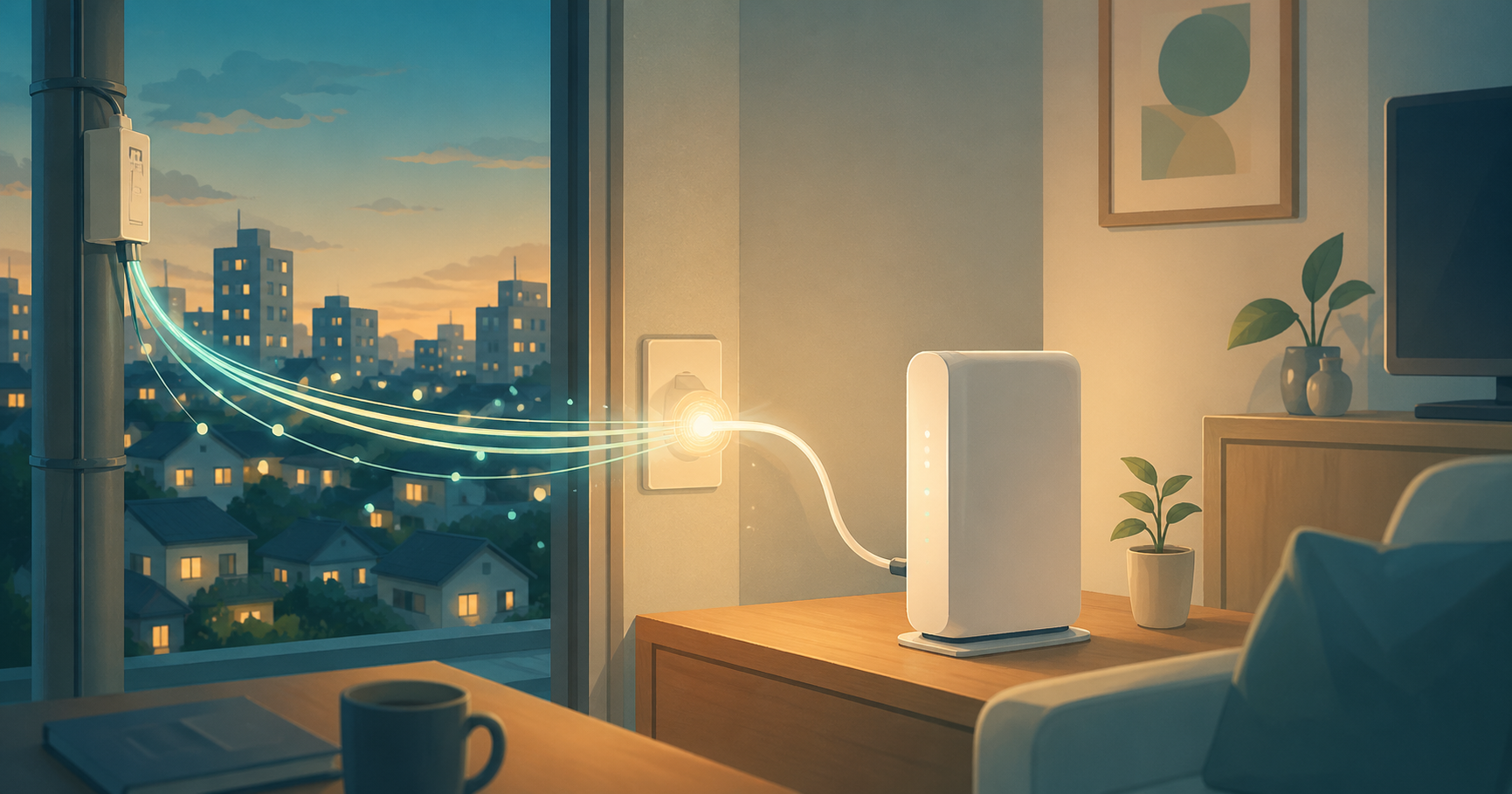
家庭向けインターネット接続は大きく3つに分かれます。第一に光回線です。建物に光ファイバーを引き込み、ONU(光終端装置)を経由してルーターに接続します。最大速度は1Gbps〜10Gbpsと圧倒的に速く、安定性も高いのが特徴ですが、開通工事に2〜4週間を要し、賃貸物件では大家の許可が必要です。第二にホームルーターです。5G/4G回線を据置型ルーターで受信し、コンセントに挿すだけで即日使用可能です。第三にポケットWi-Fiです。携帯できる小型ルーターで、出張や一時滞在に向きます。
Home internet falls into three categories. First is fiber: optical cable is run into the building and connects via an ONU (Optical Network Unit) to your router. Maximum speeds of 1-10 Gbps are overwhelmingly fast and very stable, but installation takes 2-4 weeks and rentals require landlord permission. Second is the home router: a stationary device that receives 5G/4G and works the day you plug it in. Third is pocket Wi-Fi: a portable mini-router suited to business trips and short stays.
フレッツ光という基幹網とNTT東・西
日本の光回線市場を理解するには、まずフレッツ光の存在を把握する必要があります。フレッツ光はNTT東日本・NTT西日本が運営する全国規模の光回線サービスで、日本の光回線インフラの大部分を占めています。糸魚川・静岡を結ぶ線を境に東日本と西日本に分かれており、料金や提供サービスに微妙な差異があります。フレッツ光を直接契約する場合は、別途プロバイダ(後述)を契約する必要があり、二重契約・二重請求となります。
To understand Japan's fiber market, you first need to know about Flets Hikari. Operated by NTT East and NTT West, it covers most of Japan's fiber infrastructure. The country splits at the Itoigawa-Shizuoka line into East and West, with slight differences in pricing and services. If you contract Flets Hikari directly, you must also contract a separate provider (described below) — two contracts, two bills.
光コラボ — 卸売再販による一本化
2015年にNTTが開始した光コラボレーション(通称「光コラボ」)は、フレッツ光の回線を他社に卸売し、各社が自社ブランドで再販する仕組みです。ドコモ光、ソフトバンク光、OCN光、楽天ひかり、ビッグローブ光などが代表例で、物理回線は全てフレッツ光と同じです。利用者にとっての利点は、①回線とプロバイダの料金が一本化される、②携帯キャリアとのセット割引(ドコモ・ソフトバンク・auなど)が適用される、③窓口が一つに集約されサポートが受けやすい、の3点です。
NTT launched Hikari Collaboration ("Hikari Collabo") in 2015. It wholesales the Flets Hikari line to other companies, who resell it under their own brand. Docomo Hikari, SoftBank Hikari, OCN Hikari, Rakuten Hikari, and BIGLOBE Hikari are typical examples — the physical line is identical to Flets. The user benefits are: (1) line and provider fees are bundled into one bill, (2) you get bundle discounts with your mobile carrier (Docomo, SoftBank, au, etc.), and (3) support has a single point of contact.
独自網:NURO光とauひかり
フレッツ光網に依存しない独自の光インフラを構築している事業者が2社あります。一つはソニー系のNURO光で、標準プランで下り最大2Gbpsを提供し、一般的なフレッツ光(1Gbps)の2倍の速度を実現しています。GPONという新方式を採用し、ヘビーユーザーや動画配信業務を行うエンジニアに圧倒的な人気を得ています。ただし提供エリアが首都圏・関西・東海・九州の一部に限定されている点には注意が必要です。
Two operators have built independent fiber infrastructure that does not depend on the Flets network. The first is Sony-affiliated NURO Hikari, which offers a standard 2 Gbps downstream — twice the typical Flets speed of 1 Gbps. Using the newer GPON technology, it is overwhelmingly popular among heavy users and engineers doing video-streaming work. Note, however, that service is limited to parts of Tokyo metro, Kansai, Tokai, and Kyushu.
もう一つはKDDIのauひかりです。フレッツ光と並ぶ全国規模の独自網を持ち、戸建て向けには標準1Gbps、一部エリアでは5Gbpsや10Gbpsプランも提供されています。auスマートフォンとのセット割(auスマートバリュー)が強力で、家族全員がau利用者の場合は毎月数千円の割引が受けられます。一方で、関西(eo光エリア)や東海(コミュファ光エリア)など一部地域では戸建て向けサービスが提供されない点に注意が必要です。
The second is KDDI's au Hikari. With a nationwide independent network rivaling Flets, it offers standard 1 Gbps for detached houses and 5 or 10 Gbps plans in some areas. Its bundle discount with au smartphones (au Smart Value) is powerful, saving households where everyone is on au several thousand yen per month. Note that detached-house service is not offered in some regions like Kansai (eo Hikari area) or Tokai (Commufa Hikari area).
マンションタイプと戸建てタイプの違い
光回線には建物形態に応じた2種類のプランがあります。マンションタイプは集合住宅向けで、建物の共用部まで光が既に導入されており、そこから各戸までは既存の電話配線(VDSL方式)または光配線で分岐されます。月額料金は3,500〜4,500円程度と比較的安く、工事も簡易で即日〜1週間で開通するのが一般的です。ただし配線方式がVDSLの場合は実効速度が100Mbps程度に制限されることが多く、公称1Gbpsは出ない点に注意が必要です。
Fiber plans come in two flavors based on building type. Mansion-type targets multi-unit buildings, where fiber is already drawn into the building's common area, then branched to each unit via existing phone wiring (VDSL) or fiber wiring. Monthly fees are relatively low at around 3,500-4,500 yen, installation is simple, and activation typically takes same-day to one week. Beware: when wiring is VDSL, real-world speeds are often capped around 100 Mbps — the nominal 1 Gbps is unreachable.
戸建てタイプは一戸建て向けで、電柱から直接各家に光ファイバーを引き込みます。月額料金は5,000〜6,000円程度とマンションタイプより高めですが、1Gbpsや2Gbpsの公称速度に近い実効速度が期待できます。工事は電柱からの引き込みと壁面貫通を伴うため2〜4週間を要し、賃貸戸建ての場合は大家の書面同意が必須です。
Detached-house-type targets single-family homes: fiber is drawn directly from a utility pole into each house. Monthly fees of 5,000-6,000 yen are higher than mansion-type, but real-world speeds approach the nominal 1 or 2 Gbps. Installation involves drawing from the pole and penetrating an exterior wall, taking 2-4 weeks. Renters of detached houses must obtain written landlord consent.
工事費と「実質無料」のカラクリ
光回線の開通工事費は標準で20,000〜40,000円と高額です。多くの事業者は「工事費実質無料」と宣伝していますが、実態は工事費を24〜36回の分割払いとし、同額を毎月の料金から割引するという仕組みです。つまり36か月継続利用した時点で初めて工事費が実質的に相殺されます。途中解約した場合は残債(まだ割引されていない工事費残額)を一括請求されることが多く、これが隠れた解約コストとなります。
Fiber installation costs a steep 20,000-40,000 yen as standard. Many operators advertise "effectively free installation," but in reality the fee is split into 24-36 installments and the same amount is discounted from your monthly bill. The fee is only fully offset after you have stayed continuously for 36 months. If you cancel midway, you are typically billed in a lump sum for the unwritten-off remainder — a hidden cancellation cost.
2024年改正:解約金は1か月分まで
長年、日本の光回線契約は2年または3年の自動更新縛りが標準で、更新月以外の解約には1万円〜3万円の違約金が請求されてきました。2022年7月の電気通信事業法改正により違約金の上限が1か月分の月額料金に制限され、2024年時点では全事業者がこれに準拠しています。つまり月額5,000円のプランなら解約金は最大でも5,000円が上限となり、従来の2万円超の違約金は消滅しました。ただし前述の工事費残債は別途請求されるため、実質負担は残る点に注意が必要です。
For years, Japanese fiber contracts came with standard 2- or 3-year auto-renewing lock-ins, with 10,000-30,000 yen penalties for cancellation outside the renewal month. The July 2022 revision to the Telecommunications Business Act capped the penalty at one month's monthly fee, and as of 2024 every operator complies. So if your plan is 5,000 yen/month, your cancellation fee is capped at 5,000 yen — the old 20,000-yen-plus penalties are gone. However, the installation-fee remaining balance described above is billed separately, so an effective burden still remains.
プロバイダの選定:BIGLOBE・So-net・OCN等
フレッツ光を直接契約する場合や、auひかり・NURO光を契約する場合は別途プロバイダ(インターネットサービスプロバイダ、ISP)の契約が必要です。プロバイダは実際にインターネットへの接続・認証・メールアドレスの提供を担う事業者で、BIGLOBE、So-net、OCN、@nifty、ぷららなどが代表例です。多くの光コラボでは回線とプロバイダが一体型契約になっており、個別選択は不要です。auひかりではauひかり公式提携プロバイダ(So-net、BIGLOBE等8社)から選択し、NURO光はSo-netが標準プロバイダとして組み込まれています。
For direct Flets Hikari contracts or for au Hikari and NURO Hikari, you must contract a provider (ISP) separately. The provider handles actual internet connectivity, authentication, and email — examples are BIGLOBE, So-net, OCN, @nifty, and Plala. Most Hikari Collabo plans bundle line and provider into one contract, so no separate choice is needed. au Hikari requires you to choose from eight official partner providers (So-net, BIGLOBE, etc.), and NURO Hikari ships with So-net bundled as the standard provider.
プロバイダ選定の実務基準は、①IPv6(IPoE)対応の有無、②月額料金、③キャッシュバックキャンペーンの3点です。特にIPv6(IPoE)対応は重要で、従来のIPv4 PPPoE方式は夜間や週末に網終端装置が輻輳し速度が激減する問題が頻発しますが、IPv6 IPoE方式はこのボトルネックを回避できます。現在の主要プロバイダはほぼ全てIPv6 IPoEに対応しており、ルーターの対応を確認した上で利用することが望ましいです。
Practical provider-selection criteria are: (1) IPv6 (IPoE) support, (2) monthly fee, and (3) cashback campaigns. IPv6 (IPoE) support is especially important: the traditional IPv4 PPPoE method frequently chokes at network termination devices in evenings and weekends, plummeting speeds; IPv6 IPoE bypasses this bottleneck. Almost all major providers now support IPv6 IPoE, but you should verify your router supports it before use.